








-
-

- Services
- Arrangement of management accounting and reporting
- Arrangement of bookkeeping and tax accounting
- Budget modeling
- Preparation and consolidation of financial statements in accordance with the international reporting standards (IFRS, US GAAP) and corporate procedures
- Arrangement and optimization of business processes
- Corporate structure optimization
- Analysis of the potential of development of business products and services
- Assessment of investment opportunities of business projects, business plan development, technical and economic assessment
- Financial analysis and modeling
- Due Diligence
- Solutions
- Experience
- Services
-

- Services
- Comprehensive automation of management accounting
- Development and implementation of specialized information systems
- Comprehensive automation of operative accounting
- Automation of tariff calculation and control for public utilities companies
- Arrangement and automation of banking products
- Automation of corporate document flow
- Integration and migration of information systems
- IT projects management
- Gathering and analysis of business requirements to IT solutions
- Assessment and selection of IT solutions
- Development of IT strategy
- Consulting and IT audit
- Telecommunication audit and communications system
- Solutions
- Experience
- Services
-
IT Audit
- Services
- Audit of IFRS financial statements
- RAS audit of financial statements, bookkeeping and taxation
- Consulting services and methodological support
- Outsourcing bookkeeping and tax accounting in compliance with the Russian standards
- Analysis of economic feasibility of expenses included into tariff calculation at public utility companies
- Solutions
- Experience
- HomeIPoint
- Services
-


- Treasury accounting solution “ID.Treasury”
The “ID.Treasury” solution is intended for automation of the process of management of a company’s monetary funds (treasury). The solution can be used both as an independent system or as a built-in module of the systems of financial accounting on the basis of 1C: Enterprise 8.
The main objectives of the treasury functions automation are:
-
To decrease the labour-output ratio and reduction of the accounting information processing time;
-
To increase reliability of information;
-
To enable integration with different information data sources;
-
To ensure prompt preparation of management reporting;
-
To ensure efficiency and immediacy of control.
The main functional capabilities of the management information system of the "ID.Treasury":1. Preparation and control of implementation of the financial plan;
2. Functionality to create the payment schedule;
3. Drawing up, analysis and approval of the register of payments;
4. Comparative analysis of the financial plan and the register of payments.The solution includes the following works:
-
Long-term planning of payments – one year, month, week finance plans
Considering the fact that the process of the finance plans preparation involves many services of the company(Centre of Financial Responsibility), the solution allows to prepare finance plan templates in Excel and download them to the treasury module upon the filling of the budget by the supervisors.

-
Short-term payments planning – payment schedule, requests for funds application
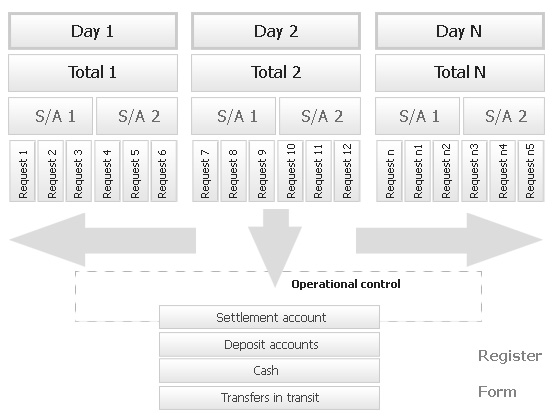
The payment schedule is created in the system by the Treasurer and is an optimal tool for distribution and payments control on the daily basis taking into account the payment schedule and availability of funds. The Treasurer takes the decision regarding the payments for the next several days on the basis of the Payment schedule, indicating which requests for payment will be finalized on which day and from which settlement account. At the same time, this document is the ground for drawing up the Payment Register document. The document has the functional for fast and convenient correction of payments. Moreover, it features the tools necessary for online processing of the document: group processing (for fast changes in properties of several payments at the same time), operating corrections (changes in the reflection of company’s financial situation in the overall balance) and snapshots (records of the financial condition of the company at a particular moment with further reconstruction of the whole picture for analysis of correctness of work of the financial service in general).
-
Storage of the versions of the payment schedule, facilities for their comparison for choosing the best option
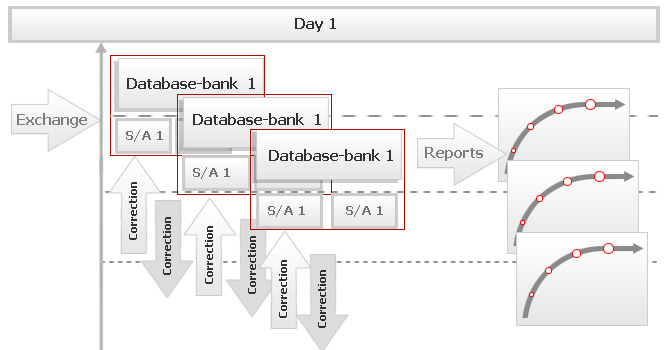
The snapshots of the financial condition are intended for saving the interim results of settlement accounts taking into account the payments. The Treasurer, recording the versions, demonstrates the results achieved at the moment of the snapshot. Later, these can be used for analysis of the payments planning process. The reports also allow to choose the snapshots (below referred to as versions) and show the condition of the payments at the moment of the version creation.
-
Approval of payments
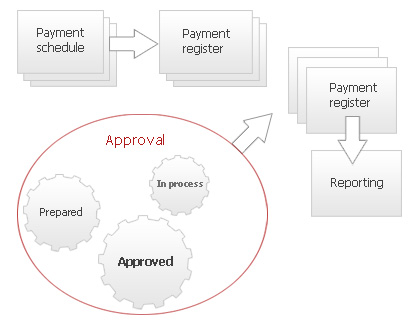
The approval process takes place upon agreement of all payments. Then the approved payment register is created. The main schedule and registers may have specifying schedules and registers.

The Payment Register is the document to be approved and acts as the final point of payment planning. Upon approval of the document, it is impossible amend the requests for expenditure included into this payment register and payment schedule, on the basis of which the payment register was created.
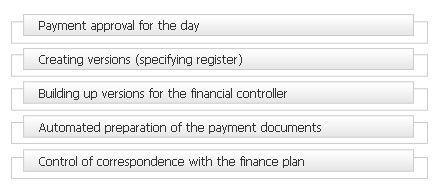
The payment register contains payments which will be performed on the date of the payment.
-
- Budgeting solution for any sector “ID.Budgeting”
The “ID.Budgeting” solution is meant for automation of the budgeting process of companies from all sectors. The mechanisms of the solution allow to cover the functions of financial planning and control and provide the financial service of the company (holding) with efficient budgeting tools.
Automation of the budgeting process with the use of the ID.Budgeting MIS ensures performance of the following tasks:
1. Drawing up the master budget of the company consisting of the income and expense budget, cash flow budget, payment schedule (operating plan of execution of the cash flow budget), pro forma balance sheet and other budgets. The drawing up of budgets may be performed in accordance with different scenarios on the basis of the target or actual data for the prior periods.
2. Planning of the monetary funding and controlling the financal condition of the enterprise for any period with a breakdown into turnover of individual items using the necessary analytical breakdowns.
3. Controlling the correspondence of the actual data with the set target indicators.
4. Controlling the correspondence of the current schedule of application of resources with the working schedule for the period and analysis of fulfillment of the budget requests.
5. Drawing up consolidated accounts based on the result of monitoring and multivariate analysis of deviations of the actual data from the target indicators.Additional features of the “ID.Budgeting” MIS:
Integration of the data from the financial accounting information system with the MIS – the actual data of the budgetary accounting is integrated from the financial accounting information systems, which allows to avoid repeated information input.
The automated business process of “Change Management” provides feedback between the budget and the supporting primary accounting documents.
The control of execution of the budget can be performed virtually at any point of the business process of the enterprise. Five main points can be singed out, in which the execution of the budget can be checked and immediate actions aimed at prevention of deviations of the actual indicators from the target ones can be taken.
Reporting. Multipurpose settings of the reports allow to prepare any reports with arbitrary analytical breakdowns and with different level of itemization. Moreover, the use of the required analytical breakdowns allows to assess the efficiency of different business lines. The plan-fact analysis can be built for each separate budget or a random list of items. This kind of report can be prepared on the basis of separate analytic objects: Centre of financial responsibility, contractor, etc, which allows to itemize the deviations.
Additional distribution procedures. It is not always possible to determine all the required analytics at the moment of posting of the actual dynamics of an item. Distribution into the preset algorithms is provided for this kind of cases. Distributed data is recorded under a different scenario, which allows to compare the data before and after the distribution.
- “ID.IFRS" - solution for management accounting
“ID.IFRS” information solution is intended for automation of management accounting of companies (holdings) from any areas of business and consolidation in accordance with the IFRS financial standards. The solution is implemented on the basis of 1C: Enterprise, which will allow to use all the advantages of this platform: accessibility, scalability, ergonomy.
The essential condition for the companies trying to attract foreign investment is preparation of IFRS reports. It is extremely important not just to obtain the reports, but rather make these reports an effective tool for analysis and support in taking management decisions.
Building the IFRS accounting model in the Company contains several stages:
-
Developing the accounting policy of the Company. The accounting policy regulates all aspects of the technology of preparation of financial statements: the main components of the reports, choice of the reporting currency, description of the transformation technology from fully functional currencies (if they are used) into the reporting currency, requirements to preparation of forms of group reporting for the Group members, etc.
-
Developing the Regulations on gathering and processing of information. This document assigns distribution of duties and the corporate regulations on gathering and processing of information during preparation and drawing up of statements.
-
Choosing, setting up and implementing the tools for preparation of financial statements. At this stage, the Company has to establish which tools it will be using for preparation of the financial statements on time and with the required level of detail.
IDelync experts, using their own experience in preparation of financial statements as the basis, as well as their excellent knowledge of our clients’ requirements to these statements, have developed an automated solution for maintaining IFRS accounting and preparation of statements.
In contrast with the most widely spread model of maintaining the accounting in Excel, this solution gives the opportunity to immediately receive “decoded” information on the items of the statements and “submerge” to each transaction or posting (which is quite often required for analysis of the situation).
Thus, significant saving is achieved by means of completeness and substantiveness, timeliness and consistency of the automatically generated IFRS reports. This means that the specialist of financial service will be able to make analysis more effectively and take timely decisions.
On the whole the solution allows to:
-
Automate processing of a greater amount of operations of the same type at the moment of transformation of RAS data into IFRS accounting (entry mapping), which allows to minimize the labour intensiveness of the IFRS accounting maintenance;
-
Itemize the reporting data before the primary discount transaction, which makes the process of checking the IFRS accounting data and collation of the RAS and IFRS data much easier;
-
Maximally decrease the influence of the human factor onto the final result of transformation of accounting data due to automation and control of preparation of statements;
-
Obtain the required analytical breakdown of the finalized statements.
The process of preparation of the consolidated financial statements in accordance with the requirements of the international standards by means of the “IFRS management accounting” solution includes the following stages:
-
Gathering the data of prime records in accordance with the requirements of the Russian legislation and its transformation into IFRS prime records;
-
Necessary alterations and missing primary information are added into the IFRS prime records obtained in the manner described above;
-
The accounting data is consolidated and in the end, the consolidated statements are prepared.
The advantages of this Solution:
-
The solution is implemented on the basis of 1C:Enterprise, which enables use of all the advantages of this platform: accessibility, scalability, open code.
-
Functionality to use different information systems (1C, “Info-Buhgalter”, “Turbo-Buhgalter”, “Parus”) as information systems which are primary information sources.
-
The functional of the system allows to set up accounting in compliance with the IFRS principles regarding “Property, Plant and Equipment”, intangible assets, inventories, which significantly simplifies the procedure of making adjustments (depreciation calculation, asset revaluation, accrual of reserves) with respect to these accounting entities.
-
The flexible system of set up of templates of financial statements and data unload into Excel accounting. There is a dedicated directory of elements of financial statements, in which the statements structure and the information source for each item of the statement are specified. On the basis of the specified structure, an Excel report template is generated automatically and it is further automatically filled in with the Solution data.
-
Roll-out of the values of the reports into consolidation tables is provided for by the mechanism of the Solution, which allows to obtain different management reports on the basis of the consolidation tables.
-
Functionality to single out the intracompany balance and prepare consolidated group statements.
The final solution and the terms of IFRS accounting automation are exclusively individual for each company. IDelync pays special attention to organization of works for preparation of the Company for the implementation, staff recruitment and training. In the course of implementation, operating and management processes in the company, document flow and financial accounting are analyzed, as well as the existing and operating information systems and technologies. The management system, put into the basis of the organization of the project works, intended for development process and implementation of complex systems and Rational Unified Process software, allows to integrate different software into a unified integrated MIS and obtain IFRS statements of adequate quality.
Significant practical experience of IDelync experts in synergy with the theoretical knowledge, allow to find adequate alternative solutions for creating an IFRS accounting system for any one occasion.
Download ID.IFRS presentation >
-

